
American cats collectively produce somewhere in the range of 2 million tons of litter waste every year. Most of that ends up in landfills, and the majority is clay — a material that takes thousands of years to break down and is extracted through a surface mining process that strips topsoil across large areas. It’s one of those environmental costs that sits quietly in the background of pet ownership, rarely talked about until someone starts actually looking into it.
That’s when flushable cat litter tends to come up — both as a disposal solution and as a broader move toward more sustainable pet care. The concept is appealing on its face. Scoop and flush rather than bag and bin. Less waste going to landfill. No plastic trash liners. Fewer trips to the outside bin. But there’s more to the category than the marketing suggests, and a few important distinctions worth understanding before you commit to a switch.
Why standard litter can’t go down the drain
Clay litter — the dominant type globally — contains sodium bentonite, a mineral famous for swelling dramatically when it absorbs water. It can expand to several times its dry volume. That property is what makes it clump so efficiently in a litter box, but it also makes it genuinely dangerous for plumbing. Clay flushed in any regular quantity will eventually build up inside pipes and cause blockages that are expensive to clear. Septic systems handle it even worse, since the solid load disrupts the bacterial breakdown processes the tank depends on.
Silica crystal litters have a similar problem. The bead format doesn’t expand the same way, but the material doesn’t break down in water either, which creates its own buildup risk over time.
Flushable litters work differently because the base materials actually decompose when wet. The most common options use corn, wheat starch, wood fiber, recycled paper, or — more recently — olive pit material. None of these harden in water. They soften and break apart, which is the basic mechanical requirement for anything going through a toilet safely.
What distinguishes the better natural litters from the mediocre ones
The flushable claim is a floor, not a ceiling. Once a litter passes the basic biodegradable test, what actually separates good products from forgettable ones comes down to clumping strength, odor control, dust output, and tracking behavior.
Clumping is where a lot of natural litters underperform relative to clay. Clay’s bentonite clumps are dense and easy to scoop cleanly. Some plant-based alternatives crumble when you try to scoop them, leaving broken fragments mixed into the clean litter and making box maintenance genuinely annoying. The formulas that do this well tend to be the ones using denser base materials — corn starch blends and olive pit litters tend to clump more firmly than paper or most wood-fiber products.
Odor control is the other sticking point. A lot of natural litters compensate for weaker clumping by adding fragrance, which trades one problem for another. Synthetic fragrance compounds are among the more common causes of skin irritation and respiratory sensitivity in cats — specifically affecting the paws, belly, and nasal passages that come into closest contact with the litter. Good odor control in a natural litter should come from absorption efficiency and clump integrity, not masking agents.
Dust is underrated as a factor. Clay creates a visible cloud when poured — fine silica particulate that’s a known respiratory irritant for both cats and humans. Natural litters vary here. Some paper-based options are surprisingly dusty for their category. Denser formats tend to perform better. Lab-confirmed 0% dust is a different claim from “low dust” or “minimal dust,” and it matters more than most product descriptions acknowledge.
Paco & Pepper: the brand that’s been making noise in this space
The olive pit litter category has a relatively short history in the US market, and Paco & Pepper has done the most to bring it to mainstream attention. The brand was launched in 2020 by Kristina Drobach, a Russian-born entrepreneur who was motivated by her own cats’ health — one developed asthma, another had persistent sneezing issues, and she traced both back to years of exposure to conventional dusty litter. She spent two years refining the formula before bringing it to market.
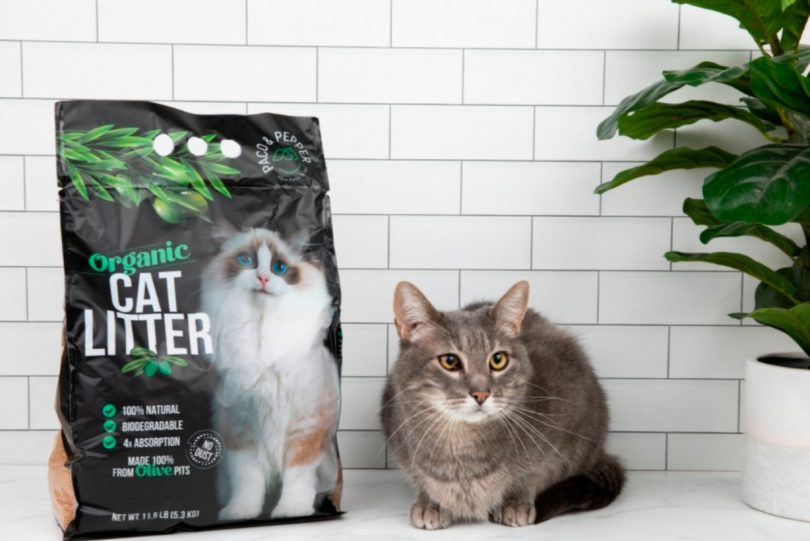
The product uses crushed olive pits — a byproduct of olive oil production, otherwise treated as agricultural waste — as its base material. The porous structure absorbs moisture quickly and binds ammonia inside the clump rather than letting it off-gas into the room. The formula is fragrance-free, chemical-free, and has been independently tested at 0% dust. It also contains natural olive oil as a minor component, which has a conditioning effect on cat paw pads.
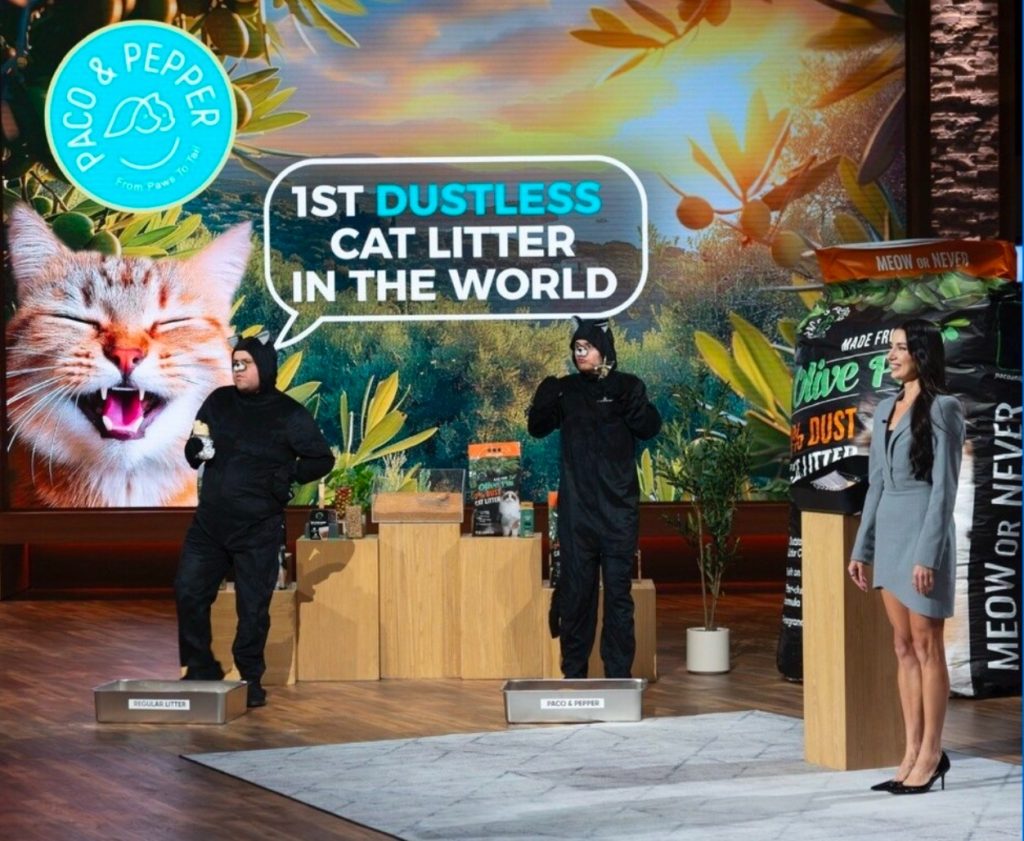
Earlier this year, Drobach took the brand to Shark Tank Season 17. She asked for $300,000 at a $6 million valuation. Lori Greiner tested the product on-camera — water poured directly into the box to watch clumping in real time. The Sharks were interested in the numbers: $1.1 million in revenue in the company’s first full year of sales, with $1.8 million already logged by the time of filming. Kevin O’Leary was the last Shark standing and made a final offer of $300,000 for 20% equity plus a per-bag royalty. Drobach walked away without a deal — the equity and royalty terms together were more than she was willing to accept — but the episode generated significant online attention and drove a meaningful spike in sales.
The brand now sells through Target, Petco, PetSmart, and several natural grocery chains alongside its direct-to-consumer website. There’s a classic unscented formula, a charcoal version for stronger odor control, and a multi-cat formula with an extra natural malodor counteractant for households running three or more boxes. Bags are 11.5 pounds and designed to last roughly a month per cat.
Verified review count sits above 9,300 at 4.7 stars, which is a substantial data set for a company this young. Recurring feedback themes: no dust cloud when pouring, reduced sneezing in cats that previously reacted to clay, and clumps that hold together through a scoop without crumbling.
The part flushable litter marketing tends to skip
Even a genuinely biodegradable litter comes with a toilet disposal caveat that matters: cat feces can carry Toxoplasma gondii, a parasite that standard wastewater treatment systems don’t reliably eliminate. Research has found toxoplasma in coastal marine ecosystems — otters and other sea mammals have been affected — with the source traced to flushed cat waste reaching the ocean via treatment plant discharge. Several US states have guidance specifically discouraging flushing of cat waste on these grounds, even with biodegradable litter.
This doesn’t make natural litter less valuable — it’s still a significant improvement over clay from both an indoor air quality and environmental landfill perspective. It just means flushing may not be the right disposal method depending on where you live and whether you’re on municipal water or septic.
Composting the waste (with appropriate precautions around the toxoplasma issue) or standard bin disposal using the biodegradable material are both options that preserve most of the environmental benefit without the wastewater concern.
Full details on formulas, subscription pricing, and retail stockists are at the Paco & Pepper website.